

The complete beginner’s guide to investing with confidence, building long-term wealth, and creating more freedom, flexibility, and choice.
Before we begin
There are thousands of articles about investing on the internet. Some are written by economists using terminology that makes you feel as though you’ve accidentally opened a university textbook. Others promise you’ll retire by thirty if you just follow their “secret strategy”. Somewhere in between are the people trying to convince you that buying random stocks because someone mentioned them on TikTok counts as a financial plan.
This isn’t one of those articles.
I wrote the guide I wish I’d been able to find when I first became interested in investing: one that assumes you’re intelligent but completely new to the subject, doesn’t expect you to know what an ETF is, and explains everything in plain English without talking down to you.
If you’re hoping to get rich quickly, you’ll probably be disappointed. If you’re looking for someone to tell you which stock is about to explode next week, you’re definitely in the wrong place. But if you want to understand how ordinary people quietly build wealth over decades, without spending their evenings analysing stock charts or refreshing finance apps every ten minutes, you’ve come to the right place.
Investing changed the way I think about money, and more importantly, the way I think about time. That’s ultimately what this guide is about. Not numbers, not spreadsheets, and not becoming obsessed with the stock market. It’s about giving yourself more choices in the future than you have today, because that’s what money really buys.
Table of Contents
- Why Almost Everything I Believed About Investing Was Wrong
- What Investing Actually Is (And What It Isn’t)
- The Mindset Shift That Changes Everything
- Saving vs Investing: Why They’re Not the Same Thing
- How the Stock Market Actually Works
- ETFs Explained (Without the Financial Jargon)
- Why Most Beginners Should Start With Index Funds
- The Quiet Superpower of Compound Interest
- How Much Money Do You Really Need?
- Choosing Your First Broker
- Building Your First Investment Portfolio
- The Biggest Mistakes New Investors Make
- What Happens When the Market Falls?
- How Often Should You Invest?
- Understanding Taxes Without Getting a Headache
- Frequently Asked Questions
- Your First 30 Days as an Investor
1. Why Almost Everything I Believed About Investing Was Wrong
For a long time, I thought investing belonged in the same category as flying a plane or performing surgery. Not because I believed it was quite that difficult, but because I assumed it required specialised knowledge that ordinary people simply didn’t have.
Investors, in my mind, were people who watched business news before breakfast, spoke confidently about market corrections over dinner, and somehow knew exactly when to buy and sell shares. They were economists, bankers, hedge fund managers, or at the very least, people who enjoyed spreadsheets far more than I ever would.
I wasn’t one of those people.
Like a lot of women, I quietly told myself I’d look into investing one day. Maybe once I earned a little more, maybe after I’d bought a house, or maybe when I finally understood what all those confusing financial terms meant. The problem with “one day” is that it has a habit of turning into five years, then ten, while life carries on.
You work hard, you save what you can, and you feel responsible because you’re not wasting money on things you don’t need. You assume you’re doing the sensible thing by keeping your savings safely tucked away in a bank account. What nobody tells you is that “safe” isn’t always the same thing as “growing.”
That was probably the biggest misconception I had. I believed the real risk was investing my money, and it never occurred to me that leaving it sitting still could be a risk too.
Inflation isn’t particularly dramatic. You don’t wake up one morning and discover half your savings have disappeared overnight. Instead, it works quietly in the background. The money is still there, but little by little it buys less than it used to. That’s a much harder loss to notice, which is probably why so many people underestimate it.
Looking back, I don’t think I was afraid of investing. I was afraid of making a mistake, and there’s an important difference. If someone had handed me €10,000 and told me to buy shares in a company I’d never heard of, I’d have panicked. Not because I thought investing itself was reckless, but because I didn’t understand what I was buying.
Once I started learning how long-term investing actually works, that fear began to disappear. Not overnight, but gradually. I realised that successful investing had far less to do with predicting the next big winner than I’d been led to believe.
In fact, most of the people who quietly become wealthy aren’t making exciting decisions every week. They’re making remarkably boring ones: investing consistently, keeping their costs low, staying invested when everyone else is panicking, and allowing time to do what time has always done.
When I first discovered that, I almost felt cheated. Why had nobody explained this before? Why had I spent years believing investing was a game reserved for financial experts when, in reality, the biggest advantage most investors have isn’t brilliance – it’s patience?
That single realisation completely changed my relationship with money. I stopped seeing investing as gambling and started seeing it as ownership. Instead of asking, “What stock should I buy?” I began asking, “How can I own a tiny piece of thousands of great businesses around the world?”
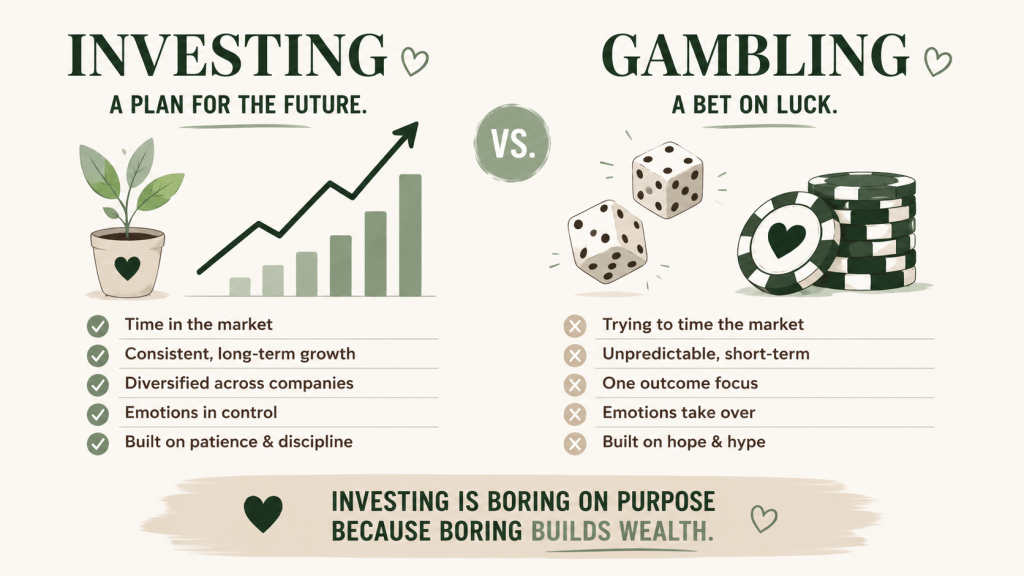
That shift might sound subtle, but it changes everything. Once you stop trying to outsmart the market and start participating in it, investing becomes surprisingly simple. Not easy, but simple.
Markets will still fall, the headlines will still tell you the world is ending every few months, and you’ll still wonder whether now is the worst possible time to invest. Everyone does. The difference is that you’ll understand what’s happening, and why history suggests patience has been rewarded far more often than panic.
If you only take one thing away from this chapter, let it be this: the biggest obstacle standing between most people and investing isn’t a lack of intelligence or a lack of money. It’s a collection of assumptions they’ve never had the chance to question.
I know, because I believed almost all of them myself.
The rest of this guide is about dismantling those assumptions, one by one.
2. What Investing Actually Is (And What It Isn’t)
Before we go any further, we need to clear up one of the biggest misunderstandings about investing.
If you asked ten people what investing means, you’d probably get ten different answers. Some would say it’s buying stocks, while others might picture Wall Street traders shouting into telephones. Someone would mention cryptocurrency, another would tell you about the uncle who lost everything in the dot-com crash, and if you’ve ever watched a film about finance, there’s a good chance your mental image involves expensive suits, champagne, and someone dramatically yelling “Sell!”
None of those things explain what investing actually is.
At its simplest, investing is nothing more than using your money to buy something that has the potential to become more valuable over time. That’s it.
Notice what isn’t in that definition. There’s nothing about predicting the market, nothing about getting lucky, nothing about staring at charts all day, and nothing about becoming an expert in economics. When you strip away all the jargon, investing is simply choosing not to let your money sit idle and instead putting it to work.
Imagine you open a small bakery. You buy ovens, employ staff, source ingredients, and begin selling bread. If the bakery is successful, it generates profits, and as the business grows, those profits increase until eventually the bakery becomes more valuable than it was when you started.
Now imagine someone offers to buy 5% of your bakery. If they take that offer, they now own a small piece of your business, and if the bakery grows, the value of their share grows too. Congratulations, they’ve just made an investment.
The stock market works in much the same way, except instead of buying part of a local bakery, you can buy tiny ownership stakes in some of the biggest companies in the world: Apple, Microsoft, Amazon, L’Oréal, Nestlé, Visa, and thousands of other businesses you’ve probably interacted with today without even thinking about it.
Every time you buy shares in a company, you’re becoming one of its owners, even if your ownership is incredibly small. That’s an important mindset shift, because you’re no longer just a customer, you’re also participating in the company’s future success.
Once I understood that, investing stopped feeling abstract. It wasn’t about numbers moving up and down on a screen anymore; it was about owning businesses that solve problems, employ millions of people, develop new technologies, and sell products that people continue buying year after year.
Of course, businesses don’t grow in a perfectly straight line. Some years are fantastic, others are disappointing, markets rise and fall, and companies succeed or fail. That’s simply part of owning businesses, and the mistake many beginners make is believing those ups and downs mean they’ve done something wrong.
Imagine buying a house with the intention of living in it for the next twenty years. Would you ask an estate agent to value it every afternoon? Probably not. If they called you tomorrow and said it was worth 3% less than yesterday, you wouldn’t immediately panic and sell it… in fact, you’d probably laugh at the idea.
Yet many people do exactly that with investments. They check their portfolio every day, become emotionally attached to short-term movements, and forget why they invested in the first place.
One of the biggest lessons you’ll learn as an investor is that volatility isn’t the same thing as risk. Those two words are often used interchangeably, but they mean very different things. Volatility simply means prices move around, while risk is the possibility that you permanently lose money.
If the value of a globally diversified investment falls by 15% during a difficult year but recovers over the following years, that’s volatility. If you panic, sell everything during that fall, and lock in your losses, that’s when temporary volatility becomes permanent.
This is one of the reasons successful investing is often described as being more psychological than mathematical. Most people don’t struggle because investing is too complicated, they struggle because our brains weren’t designed to stay calm while watching numbers fall.
We’ll come back to that later in this guide, because understanding your own behaviour is just as important as understanding the stock market itself.
For now, I want you to remember one simple idea: investing isn’t about finding the perfect company, becoming the smartest person in the room, or making money as quickly as possible. It’s about buying productive assets, giving them time to grow, and resisting the urge to interfere every time the news tells you the world is ending.
Everything else – the ETFs, the brokers, the portfolios – is simply the practical side of putting that idea into action.
3. The Mindset Shift That Changes Everything
When I first became interested in investing, I thought I was learning how to make more money.
It didn’t take long to realise I was actually learning something much bigger.
Until that point, I’d always viewed money in fairly simple terms. I worked, I got paid, I paid my bills, and if there was anything left at the end of the month, I’d move some of it into my savings account. It felt responsible, and to be fair, it was. Saving money is a good habit, and having an emergency fund is one of the smartest financial decisions you can make.
But saving and building wealth aren’t quite the same thing. That distinction completely changed the way I thought about my finances.
For most people, earning money depends almost entirely on one thing: their time. We go to work, exchange our time and skills for a salary, and repeat the process again the following month. If we stop working for whatever reason, the income usually stops too. That’s simply how employment works, and there’s absolutely nothing wrong with it.
The problem is that time has limits.
There are only so many hours you can work in a day, only so many promotions you can earn, and only so much you can increase your income through your own effort alone. Eventually, everyone reaches a point where working harder becomes an increasingly difficult way to move forward financially.
That’s where investing changes the conversation.
Instead of relying solely on your next payslip, you begin buying assets that have the potential to grow independently of the hours you personally work. The first time someone explained that idea to me, it sounded almost too simple. Surely it couldn’t be that straightforward?
In reality, it is.
Think back to the bakery example from the previous chapter. If you owned part of a successful bakery, the business wouldn’t suddenly stop selling bread because you decided to spend the afternoon at the beach. Customers would still walk through the door, staff would still do their jobs, and the bakery would continue trying to grow whether you were there or not.
The same principle applies when you invest in businesses through the stock market. The companies you’ve invested in don’t stop developing products because you’ve gone on holiday. They don’t pause innovation because you’re asleep. Every day, thousands of people go to work with one objective: to make those businesses more valuable than they were yesterday.
As a shareholder, even a very small one, you benefit if they succeed.
That was the moment everything clicked for me.
I stopped thinking of investing as a way to “make money” and started thinking of it as buying tiny pieces of businesses that were working on my behalf every single day. Not because they knew who I was, but because that’s exactly what successful businesses are designed to do. They innovate, they grow, they generate profits and, over long enough periods of time, many of them become more valuable.
Once you start looking at investing through that lens, you also stop asking a question that traps a surprising number of beginners.
“How much money can I make?”
Instead, you begin asking a much more useful one.
“How many productive assets can I own over my lifetime?”
It might seem like a small shift in wording, but it changes your behaviour in remarkable ways. You’re no longer looking for the next hot stock or wondering whether now is the perfect time to buy. You’re simply focused on gradually increasing your ownership of productive assets, knowing that time is likely to do much of the heavy lifting.
That’s also why I no longer see investing as something reserved for wealthy people.
In fact, I’d argue the opposite.
People who are already wealthy have more money to invest, but investing itself is one of the main reasons many ordinary people become wealthier over time. They don’t necessarily earn extraordinary salaries or discover secret investment strategies. They simply start earlier than most people, invest consistently, and allow compounding to work quietly in the background for years or even decades.
That last part is important because investing isn’t really about becoming rich overnight. If that’s what you’re looking for, you’ll almost certainly end up disappointed.
It’s about slowly increasing the gap between what you earn and what you own.
At first, almost everything you have comes from your salary. As time passes, your investments begin contributing too. Then, gradually, they contribute more. Eventually, if you stay consistent for long enough, you reach a point where your money is generating meaningful growth alongside your monthly income.
That’s when you realise the biggest benefit of investing was never the numbers on a screen. It was the options those numbers created. The option to reduce your working hours. The option to walk away from a job that no longer makes you happy. The option to walk away from a relationship without being financially dependent. The option to take time off without feeling financially trapped. The option to retire earlier than you thought possible, or simply to work because you enjoy it rather than because you have no alternative.
That’s why investing has never really been about money for me.
Money is simply the tool.
What you’re really building is freedom, one investment at a time.
4. Saving vs Investing: Why They’re Not the Same Thing
One of the questions I hear most often from people who are new to investing is surprisingly simple:
“If investing generally produces better returns than leaving money in a savings account, why wouldn’t I just invest all of my money?”
At first glance, it seems like a sensible idea. If your investments have the potential to grow faster than your savings, it feels logical to put every spare pound to work as quickly as possible.
But the reality is a little more nuanced.
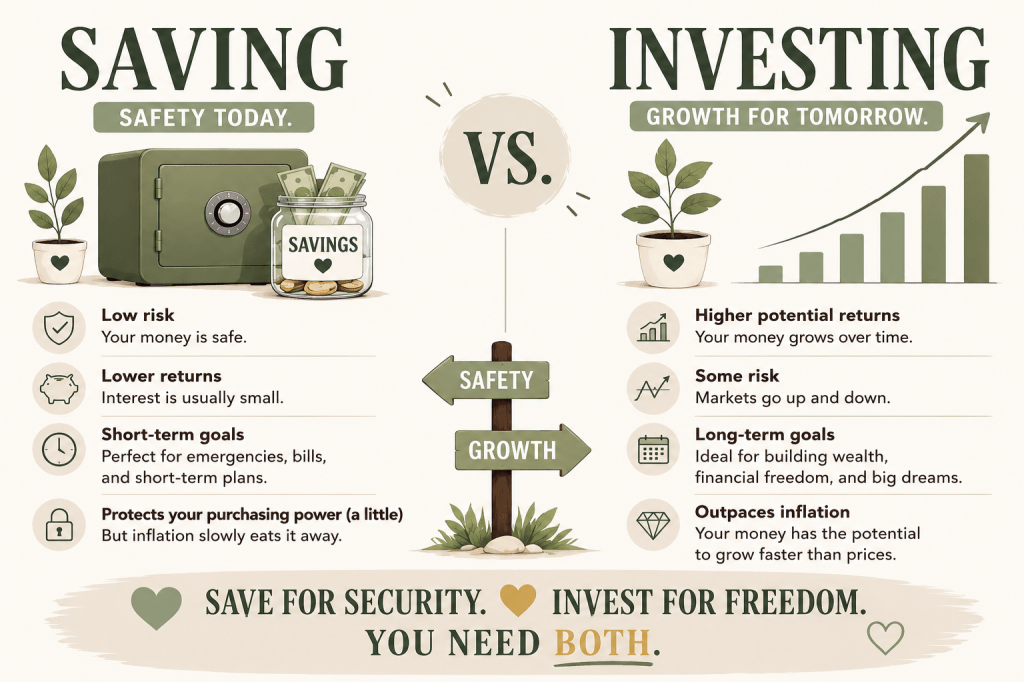
Saving and investing are often talked about as though they’re competing with each other, when in fact they serve completely different purposes. One isn’t better than the other in the same way that a hammer isn’t “better” than a screwdriver. They’re simply designed to solve different problems.
Saving is about protecting money you’ll probably need in the near future, while investing is about growing money you hopefully won’t need for many years. That distinction might seem subtle, but it’s one of the most important ideas you’ll learn as an investor.
To see why, imagine you’ve spent the last two years saving €15,000 because you’re planning to buy a house next summer. Would it make sense to invest that money in the stock market just a few months before you need it?
Probably not.
The issue isn’t that investing suddenly becomes a bad idea. It’s that markets don’t move according to your personal timeline. If your investments happen to be worth 20% less six months from now because the market has entered a temporary downturn, you don’t have the luxury of waiting for things to recover. You need the money when you need it.
That’s why money with a short-term purpose generally shouldn’t be invested.
The same logic applies to your emergency fund. Life has a habit of being unpredictable: boilers break, cars need repairs, employers restructure, and unexpected bills appear. None of these events are unusual, but they can become serious problems if you’re not prepared.
An emergency fund exists so that these moments don’t force you into making bad financial decisions.
Imagine losing your job during a market downturn. If all of your money is invested, you might find yourself selling investments at exactly the wrong time just to cover your expenses. That’s a situation you want to avoid if at all possible.
Having money sitting safely in a savings account isn’t a sign that you’re missing out. It’s what allows the rest of your investments to remain untouched when life inevitably throws you a curveball.
Once I understood that, I stopped seeing my savings account as an underperforming investment and started seeing it for what it really was: an insurance policy.
Its purpose wasn’t to grow as quickly as possible. Its job was to be available immediately, whenever I needed it, without worrying about what the stock market happened to be doing that week.
Everything beyond that emergency fund had a different role.
Money I knew I wouldn’t need for at least ten years could afford to experience the ups and downs of the market because time was on my side. If markets fell next month, it simply didn’t matter very much. In fact, as we’ll discuss later, continuing to invest during downturns has historically been one of the most effective things long-term investors can do.
This is where many beginners accidentally make things harder for themselves. They assume every pound has to do the same job, when in reality different money serves different purposes.
Some money is there to keep you safe. Some is there to give you flexibility and peace of mind. Some is set aside for shorter-term goals like holidays, weddings, or a new car. And some is meant for a version of yourself who doesn’t exist yet.
Keeping those “money purposes” separate makes financial decisions much easier. Instead of constantly wondering whether you should spend or invest every euro you earn, you simply decide what role that money is meant to play.
Personally, I find this approach far more practical than trying to follow rigid budgeting rules.
When I receive my salary, I’m not choosing between saving and investing. I’m allocating money to different future versions of my life. Some of it belongs to next month, some to next year, and some to the person I’ll be twenty years from now.
Those are very different people with very different needs.
Once you start thinking this way, the relationship between saving and investing becomes much clearer. They aren’t competing strategies, and they certainly aren’t enemies.
They’re partners. One provides stability, while the other provides growth. You need both.
Trying to build wealth without savings is like building a house without foundations. Eventually, something unexpected will force you to undo part of what you’ve spent years creating. On the other hand, relying only on savings means your money never really gets the chance to grow alongside the world’s most productive businesses.
The healthiest financial plan almost always includes both. A solid emergency fund gives you confidence. Long-term investments give you opportunity. Together, they give you something that’s surprisingly rare when it comes to money: peace of mind.
5. How the Stock Market Actually Works
For something that has such a huge impact on our financial lives, the stock market is surprisingly mysterious.
Most of us hear about it for years before we ever understand what it actually is. We see headlines announcing that “the market is up” or “the market has lost billions”, but very few people ever stop to explain what those headlines really mean.
If I’m honest, I used to picture the stock market as a giant building somewhere in New York filled with people shouting across a room while numbers flashed on enormous screens.
That image isn’t entirely fictional (stock exchanges like the New York Stock Exchange certainly exist) but it also isn’t how most investing works today.
The stock market isn’t one single place. It’s a network that allows investors to buy and sell ownership in publicly listed companies.
To understand why that matters, let’s go back to our bakery.
Imagine your bakery has become incredibly successful. Business is booming, customers are queuing outside every morning, and you’re thinking about opening ten more locations across the country. Expanding, however, is expensive. You need larger premises, more staff, better equipment and a significant amount of capital.
You have several options. You could borrow money from a bank, find private investors willing to fund the expansion, or decide to sell small ownership stakes in your business to the public.
That’s essentially what happens when a company decides to “go public”.
Instead of being owned by just a handful of founders or private investors, ownership is divided into millions, or sometimes billions, of small pieces called shares. Those shares are then bought and sold on a stock exchange, allowing anyone with an investment account to become a tiny part-owner of the business.
If you’ve ever bought shares in companies like Apple, Microsoft or Coca-Cola, you’ve done exactly that. You’re not lending those companies money, you’re buying ownership.
That distinction matters because owners and lenders are treated very differently. If you lend money to someone, you expect to be paid back. If you own part of a business, your investment rises or falls depending on how that business performs over time.
Once a company’s shares begin trading publicly, their price doesn’t stay fixed.
Every trading day, millions of investors decide whether they want to buy or sell. If more people want to buy a company’s shares than sell them, the price generally rises. If more people want to sell than buy, the price usually falls.
At first, that can seem a little strange, because a company’s value doesn’t suddenly change every second.
Apple doesn’t become a worse business because its share price falls by 2% on a Tuesday afternoon, just as it doesn’t magically become 2% better because the share price rises on Wednesday morning.
Share prices move because investors constantly reassess what they believe a business is worth. Sometimes those judgements are sensible, and sometimes they’re driven by fear, excitement or uncertainty. This is why markets can occasionally behave in ways that seem irrational.
Companies can report excellent results and still see their share price fall because investors expected even better results. On the other hand, a struggling company might see its share price rise simply because its results weren’t quite as bad as people feared.
This is one of the reasons I try not to pay too much attention to daily market movements. They tell you what investors are feeling today, but they don’t necessarily tell you what a business will be worth ten years from now.
As a long-term investor, that’s an important distinction.
Imagine buying a flat with the intention of renting it out for the next thirty years. If someone knocked on your door every afternoon and offered to buy it for a slightly different price, you probably wouldn’t rush to make a decision every single day. Unless you were planning to sell immediately, those daily offers wouldn’t matter very much.
The stock market works in a remarkably similar way. Every day, it’s effectively offering you a new price for the businesses you own, sometimes higher than yesterday and sometimes lower.
The businesses themselves, however, continue doing what they’ve always done. They’re developing products, hiring staff, opening new markets and trying to increase their profits regardless of what the share price happened to do that morning.
Understanding that relationship between businesses and share prices is one of the biggest turning points for new investors.
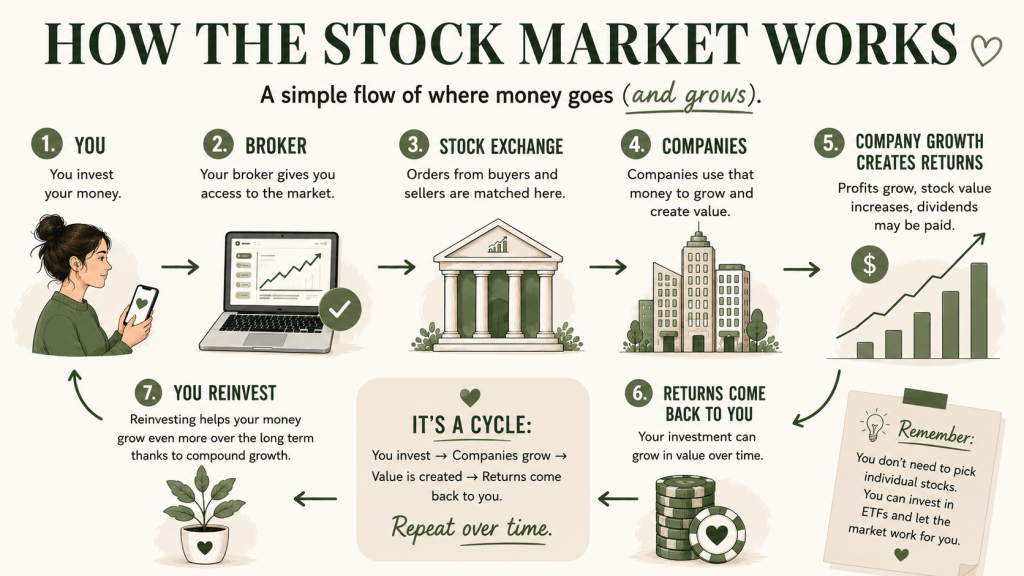
Once you realise that the stock market is simply a marketplace where ownership changes hands, it becomes far less intimidating. You’re no longer looking at mysterious green and red numbers flashing across a screen, but at millions of people trying to decide what businesses are worth.
Sometimes they’ll be right, and sometimes they’ll be wrong.
Fortunately, successful investing doesn’t require you to know the difference.
They simply need to learn how to participate in it.
That’s exactly where ETFs come in, and they’re about to make everything you’ve read so far much easier.
6. ETFs Explained (Without the Financial Jargon)
If you’ve made it this far, you’ve already understood something that many people never do: investing isn’t about gambling, predicting the future or becoming a financial expert. It’s simply about owning productive assets over the long term.
That naturally leads to the next question: if buying shares in businesses is such a sensible way to build wealth, how do you decide which companies to invest in?
When I first started looking into investing, I assumed this was where things became complicated. Every article seemed to mention different companies, different sectors and different strategies. Some people insisted technology stocks were the future, while others argued healthcare was the safer choice. Then there were dividend investors, growth investors, value investors, and people who somehow seemed convinced they could predict exactly which company would dominate the next decade.
It all felt exhausting.
Fortunately, there’s another option. Instead of trying to decide which individual companies deserve your money, you can simply buy a tiny piece of hundreds, or even thousands, of companies all at once.
That’s exactly what an ETF allows you to do.
ETF stands for Exchange Traded Fund, which sounds far more complicated than it really is. The name itself isn’t particularly important. What matters is understanding how it works.
Imagine walking into a supermarket with the goal of buying fruit. You could spend an hour carefully choosing individual apples, bananas, oranges and strawberries, hoping you’ve picked the very best of each. Or you could simply buy a fruit basket that’s already been put together for you. You might not get the single best apple in the shop, but you also won’t accidentally walk out with ten rotten bananas. An ETF works in much the same way.
Instead of buying individual companies one by one, you’re buying a basket of investments that has already been assembled according to a particular set of rules. Some ETFs track the world’s largest companies, others focus on American businesses, European businesses, technology companies or emerging markets.
When you buy one share of that ETF, you’re effectively buying a tiny slice of every company inside it.
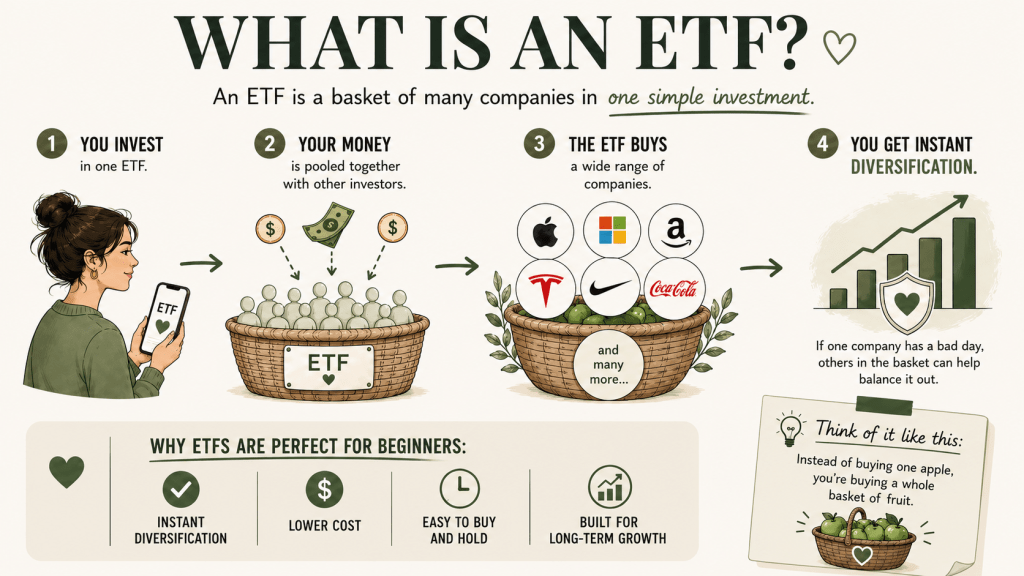
Let’s take one of the world’s most popular ETFs as an example: an S&P 500 ETF.
Rather than deciding whether Apple is a better investment than Microsoft, or whether Amazon will outperform Nvidia over the next decade, the ETF simply owns all of the companies that make up the S&P 500 index. If one company performs brilliantly while another has a disappointing year, the overall fund adjusts naturally because you’re invested in the entire group rather than relying on a single winner.
That’s one of the reasons ETFs have become so popular over the last two decades. They remove an enormous amount of guesswork.
Instead of asking yourself, “Which company should I buy?”, you’re asking a much simpler question: “Which collection of companies do I want to own?”. That shift completely changed the way I looked at investing.
I realised I didn’t actually want the pressure of trying to predict which business would dominate the next ten years. I was perfectly happy owning hundreds of successful companies and allowing the market to decide which ones would thrive. Ironically, that’s exactly what many professional investors struggle to do.
Every year, thousands of fund managers are paid enormous salaries to pick what they believe will be tomorrow’s winning companies. They employ teams of analysts, spend millions on research and have access to more information than the average investor could ever hope to obtain.
Yet year after year, a large proportion of them fail to outperform simple index-tracking ETFs over the long term.
That surprises many beginners because we’re naturally drawn to the idea that more effort should produce better results. We assume the smartest investors must have discovered a secret formula that everyone else has missed.
Most of the evidence suggests otherwise. In many cases, investing less actively has turned out to be remarkably effective. That doesn’t mean ETFs are perfect.
Like every investment, they can rise and fall in value, and different ETFs carry different levels of risk depending on what they invest in. An ETF focused entirely on technology companies will behave very differently from one that owns thousands of businesses across the global economy.
That’s why choosing an ETF still requires some thought.
The important difference is that you’re choosing a strategy rather than trying to predict individual winners. Personally, I find that approach far more realistic.
I have no idea whether one particular company will become twice as valuable over the next fifteen years. I also don’t pretend to know which CEO will make the best decisions or which industry will produce the next breakthrough innovation.
What I do believe is that, over long periods of time, businesses will continue solving problems, creating products, generating profits and finding new ways to improve our lives. Owning a broadly diversified ETF allows me to benefit from that progress without having to guess exactly where it will come from. For most people, that’s more than enough.
It’s also one of the biggest reasons investing has become so much more accessible than it was a generation ago. You no longer need to build a complicated portfolio containing dozens of individual companies just to achieve diversification. With a single purchase, it’s possible to own a small part of hundreds or even thousands of businesses around the world.
As you’ll see in the next chapter, that simple idea has another advantage that makes it particularly well suited to beginner investors. It allows you to benefit from one of the oldest pieces of investment advice ever given: don’t put all your eggs in one basket.
7. Why Most Beginners Should Start With Index Funds
If you’ve been following along so far, you might have noticed that I’ve been steering you towards ETFs that track an index rather than talking about buying individual companies.
At some point, almost every new investor asks the same question:
“If buying an ETF means owning hundreds of companies, wouldn’t I make more money if I simply picked the best ones instead?”
On paper, the answer is yes.
If you somehow knew today which companies were going to become the biggest winners over the next twenty years, buying only those companies would almost certainly outperform buying the market as a whole.
The difficulty, of course, is that nobody has that information.
It’s easy to convince yourself that investing would have been simple if only you’d bought Apple twenty years ago or Amazon before online shopping exploded. Looking backwards, the winners seem obvious. Looking forwards, they’re anything but.
That’s one of the biggest traps new investors fall into. We only remember the success stories. Very few people talk about the companies that once looked just as promising but slowly disappeared, were overtaken by competitors or simply never lived up to expectations. History is full of businesses that seemed unstoppable at one point, only to become largely irrelevant a decade later.
The challenge isn’t identifying yesterday’s winners. It’s identifying tomorrow’s. That’s exactly what an index fund helps you avoid.
Instead of asking you to predict which companies will dominate the future, an index simply reflects the market as it exists today. As businesses grow, shrink, succeed or fail, the index gradually changes with them. Companies that become more important naturally make up a larger percentage of the index, while businesses that decline become less significant or eventually disappear altogether.
In other words, you don’t have to decide who tomorrow’s winners will be. The market does that for you. I find that idea surprisingly reassuring.
The more I learned about investing, the more comfortable I became admitting that I have absolutely no idea which company will dominate the next twenty years. I don’t know what technology will change the world next, which CEO will make the smartest decisions, or which start-up will become tomorrow’s household name.
Fortunately, I don’t need to know. By investing in a broad index fund, I can own a small part of all of those businesses and allow time to sort the winners from the losers.
That might sound like settling for average, but that’s another common misconception.
People often hear the phrase “average market return” and immediately assume average means mediocre. In everyday life, average usually isn’t something we aspire to. Nobody dreams of having average health or an average holiday.
Investing is one of the rare areas where “average” is actually an incredibly high standard.
Remember, the market isn’t made up of average businesses. It contains many of the most successful companies in the world. By buying an index fund, you’re not settling for second best. You’re choosing to participate in the long-term growth of thousands of businesses rather than betting that you’ll consistently identify the handful that outperform everyone else.
Professional investors have been trying to do exactly that for decades. Every year, actively managed funds spend millions on research. Teams of analysts analyse financial statements, interview company management, build complex valuation models and search for opportunities they believe the rest of the market has overlooked. Despite all of that expertise, many actively managed funds still fail to outperform simple index funds over long periods, especially once their fees are taken into account.
That doesn’t mean active investing never works. Some investors do beat the market. The problem is that it’s incredibly difficult to know who those investors will be before the fact, and even harder to know whether they’ll continue doing so over the next ten or twenty years. Personally, I’d rather build my financial future around something I can reasonably expect to work than something I hope might work.
There’s another reason I like index investing, and it’s one that isn’t discussed nearly often enough. It protects you from yourself.
Imagine spending months researching a company before finally deciding to invest. A few weeks later, the share price falls by 25%. Would you feel completely relaxed?
Probably not.
Most of us would immediately begin wondering whether we’d made a terrible mistake. We’d read more headlines, search for reassurance online and question whether we should sell before things became even worse.
That’s perfectly normal. It’s also one of the reasons so many people struggle with investing. When your portfolio consists of just a handful of companies, every piece of news feels personal.
Index funds make that emotional rollercoaster much easier to manage because your success no longer depends on one company getting everything right. One business might have a disappointing year while another exceeds expectations. Over time, the strongest companies naturally make up a larger share of the index, while weaker businesses become less important. You don’t have to keep making those decisions yourself. That’s exactly what the index is designed to do.
Does that mean you should never buy individual shares?
Not necessarily.
If you genuinely enjoy researching companies and understand the risks involved, there’s nothing wrong with owning individual stocks alongside your core portfolio. Many experienced investors do exactly that. This is called a core (index) and satellite (individual stocks) approach.
The key phrase there is alongside your core portfolio.
Personally, I think there’s a big difference between investing and speculating. Buying a broadly diversified index fund is a long-term investment strategy. Buying a handful of companies because you think they’ll outperform the market is a prediction.
Predictions can be right. They can also be spectacularly wrong.
For someone who’s just beginning their investing journey, I think it’s worth removing as many unnecessary variables as possible. You don’t need to predict the next Nvidia to become a successful investor. You don’t need to discover a hidden gem before everyone else. You don’t even need to outperform the market.
You simply need to own it.
Once I accepted that, investing became a lot less stressful – and, perhaps surprisingly, a lot more enjoyable.
The next chapter explains why one simple ingredient has historically mattered even more than choosing the perfect investment: time.
8. The Quiet Superpower of Compound Interest
If you’ve ever spent more than a few minutes reading about investing, you’ve almost certainly come across the phrase compound interest.
It’s one of those concepts that’s mentioned so often it almost loses its meaning. Every finance book talks about it, every investing podcast praises it, and someone will inevitably quote Albert Einstein and call it “the eighth wonder of the world” (even though there’s no real evidence he ever said that).
For a long time, I understood the definition of compound interest without really understanding why it mattered.
I knew that my investments could generate returns, and that those returns could then generate returns of their own. It made sense in theory, but it still felt like one of those ideas that only became interesting if you were already wealthy.
Then I saw the numbers.
Imagine two friends. The first starts investing €250 every month at the age of 25 and continues doing so until they’re 65. The second decides they’ll wait until they’re 35 because life is expensive, they’re saving for a house, and they’ll “catch up later”.
They invest exactly the same amount every month from that point onwards.
The difference is simple: the first person has given their money an extra ten years to compound.
Those ten years don’t just add another decade of contributions. They give every euro invested during that period another ten years to grow, and every gain generated during those years has another decade to generate gains of its own. That’s the part many people underestimate.
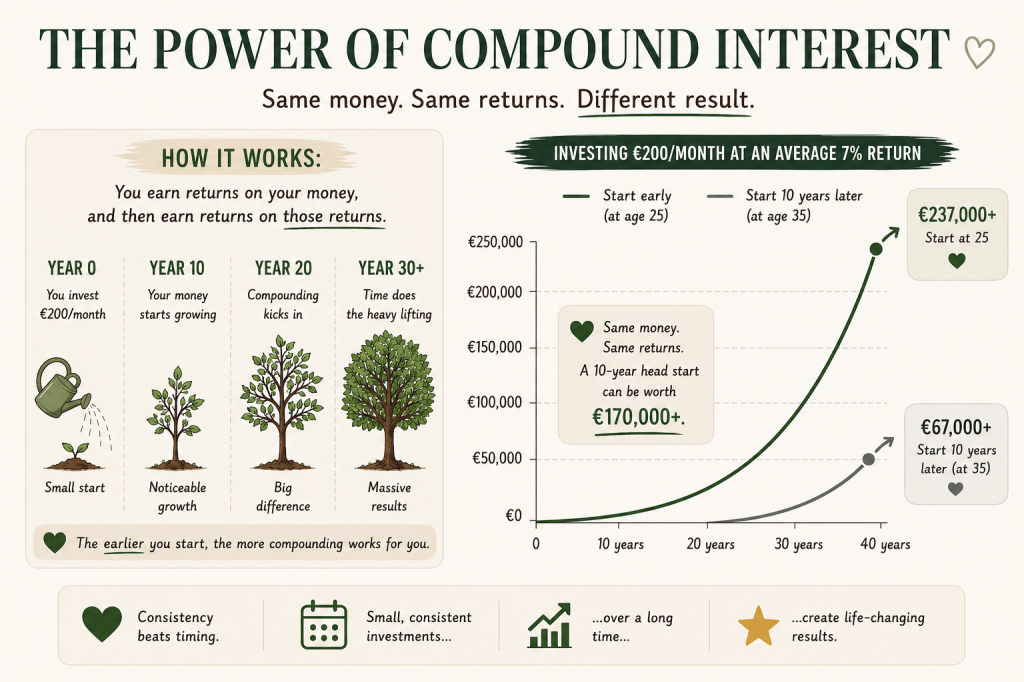
Compound interest isn’t linear. It doesn’t grow in a straight line.
In the early years, progress can feel almost disappointing. You invest consistently, you check your account after twelve months, and although it’s encouraging to see growth, it certainly doesn’t feel life-changing. That’s because, in the beginning, most of the growth comes from you. You’re contributing money every month while your investments are still relatively small.
Fast forward another fifteen or twenty years and the balance begins to shift. Your portfolio has become much larger, which means even modest percentage gains translate into much bigger amounts of money. Suddenly, your investments are doing a larger share of the work than your monthly contributions.
That’s when compounding starts becoming impossible to ignore.
One of my favourite ways to think about it is by imagining a snowball rolling down a hill. At the top of the hill, it’s tiny. You have to keep pushing it, and it doesn’t seem to collect much snow at all. After a while, though, something changes. The snowball becomes large enough that every full rotation picks up significantly more snow than the rotation before it. By the time it reaches the bottom of the hill, it’s growing far faster than it ever did at the beginning.
Investing works in much the same way.
The frustrating part is that most people give up while they’re still pushing the snowball. Those first few years don’t feel particularly exciting. Your portfolio might only grow by a few hundred euros despite all the money you’ve invested, and it’s tempting to wonder whether it’s really making any difference.
It is! You just haven’t reached the stage where compounding becomes visible yet.
That’s why time is such an extraordinary advantage. People often focus on trying to earn a higher return by finding the perfect investment, but a few extra percentage points are often less important than simply giving your money more years to grow.
Someone who starts investing consistently at twenty-five doesn’t necessarily need to be a better investor than someone who starts at thirty-five. They’ve simply allowed time to do more of the work.
That doesn’t mean you’ve missed your chance if you’re reading this in your thirties, forties or beyond!
One of the most common reactions people have after learning about compound interest is regret. They wish someone had explained it to them earlier. I understand that feeling, I had exactly the same thought when I started investing at 32 years old.
But spending years regretting the past only delays the moment you finally begin.
The second-best time to start is still today.
Every year you wait is one less year your investments have to compound, but every year you do invest is another year working in your favour. That’s a far more useful way to look at it.
When I think about investing now, I rarely focus on what my portfolio is worth today. Instead, I think about what the decisions I’m making now could mean ten, twenty or thirty years from now. It’s a much longer conversation, and it’s the one that compound interest rewards.
Because the remarkable thing about compounding isn’t that it makes people rich overnight. Its real strength is that it quietly rewards consistency for far longer than most people realise.
You don’t need to invest enormous amounts of money. You don’t need to discover extraordinary investments. You simply need to begin, remain consistent, and allow time to do what it has always done.
That’s why experienced investors are so obsessed with starting early. Not because the first few years produce spectacular results, but because those first few years often become the most valuable years of all.
9. How Much Money Do You Really Need?
One of the biggest reasons people postpone investing has nothing to do with the stock market itself. It’s because they assume they don’t have enough money to make it worthwhile.
I used to think exactly the same way. In my head, investing was something people started doing once they had a high-paying job, a mortgage, and tens of thousands sitting in a savings account. Until then, I assumed there wasn’t much point. What difference could investing €100 or €200 a month possibly make?
As it turns out, quite a lot.
The difficult thing about investing is that the results rarely look impressive at the beginning. If you invest €100 this month, you’re not going to wake up next week feeling wealthier. Even after a year of consistent investing, your portfolio probably won’t have changed your life. That’s where many people become discouraged.
We’re used to seeing immediate results. If you go to the gym consistently, you’ll eventually notice changes in the mirror. If you study for an exam, you’ll hopefully receive a better grade. Investing doesn’t offer that same instant feedback. For quite a while, it can feel as though nothing particularly exciting is happening.
The mistake is assuming that because the early results are modest, the long-term results will be too. They won’t.
As we discussed in the previous chapter, investing isn’t about what happens over the next twelve months. It’s about what happens over the next twenty or thirty years. Time changes the equation completely.
Let’s imagine two people. The first waits until they can comfortably invest €1,000 every month, which takes them another eight years to reach. The second starts today with €150 a month and increases that amount whenever their salary grows.
Who ends up with the larger portfolio? Without knowing the exact numbers, it’s impossible to say for certain. But what matters is that the second person has already given compounding eight extra years to work, which is a powerful head start.
This is one of the reasons I’ve become far less interested in finding the “perfect” monthly investment amount. Consistency matters far more than perfection.
Of course, that doesn’t mean everyone should invest exactly the same amount. Personal finance is exactly that: personal. Someone earning €2,000 a month will have very different financial priorities from someone earning €8,000. A parent with young children will almost certainly structure their finances differently from someone living alone, and someone paying off expensive debt should probably focus on that before aggressively investing.
What is helpful, however, is getting into the habit of investing regularly, even if the amount feels smaller than you’d like. Habits tend to grow, while waiting for the “perfect” moment often doesn’t lead anywhere.
As your income increases over the years, your investments can increase alongside it. A contribution that starts at €100 a month might eventually become €250, then €500, and perhaps much more later in your career. You don’t have to begin at your final destination, you simply have to begin.
This is also why I don’t particularly like comparing portfolios. Social media makes it easy to feel as though everyone else started earlier, earns more money, or has somehow figured out the secret to becoming wealthy before the age of 25. In reality, you’re usually seeing a highlight reel rather than the full picture.
Some people inherited money, some have exceptionally high incomes, some invested through one of the strongest bull markets in history, and some are taking far more risk than they realise. Comparing your own progress to someone else’s circumstances is rarely helpful because you’re not running the same race.
The only comparison that really matters is whether you’re making decisions that improve your own future compared with where you were a year ago.
There’s one final point that’s often overlooked. Many people ask, “What’s the minimum amount I can invest?” A better question is, “What’s the maximum amount I can invest without making my life worse today?” Those are very different questions.
Investing shouldn’t mean never going on holiday, never eating out, or feeling guilty every time you spend money on something you enjoy. Building wealth is important, but so is building a life you actually want to live.
The goal isn’t to save every possible dollar. The goal is to find a balance you can comfortably maintain for decades, because that’s ultimately what successful investing looks like: not a few months of extreme discipline followed by giving up altogether, but a sensible plan that quietly continues in the background while you get on with living your life.
The exact amount you invest each month matters, but the habit of investing consistently matters even more. And that’s good news, because habits are something every investor can start building today.
10. Choosing Your First Broker
If you’ve made it this far, you’ve already done the hardest part. You understand what investing is, why long-term investing works, why diversification matters and why so many experienced investors choose broad index funds. At this point, there’s really only one practical step left before you can begin: you need a place to actually buy your investments.
That’s where brokers come in. A broker is simply a platform that allows you to buy and sell investments, acting as the bridge between you and the stock market. Years ago, this process involved phone calls, paperwork and significant fees. Today, opening an investment account is usually quick, straightforward and can often be completed in less time than setting up a new social media profile.
Despite this simplicity, the number of brokers available can feel overwhelming at first. Every platform claims to be the easiest, the cheapest or the most advanced. Some emphasise commission-free investing, others highlight sophisticated trading tools, while a growing number focus on making investing feel engaging through colourful apps and constant notifications. While these features may sound appealing, they are not necessarily aligned with the needs of a long-term investor.
When choosing a broker, the goal is not to find the most exciting platform, but one that supports consistent, long-term investing. This shifts the focus away from design and novelty, and towards a smaller set of more meaningful criteria.
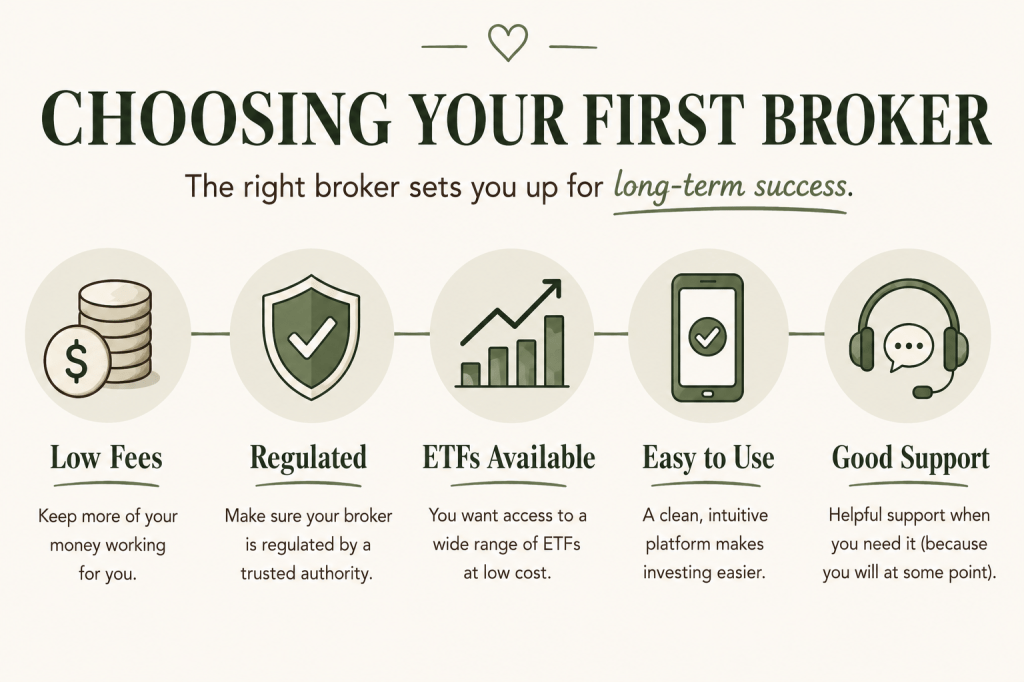
The first of these is regulation. Your broker should be properly regulated in the country or region where it operates. Although this may not be the most interesting aspect of investing, it is one of the most important. A well-regulated broker provides reassurance that your investments are held according to strict financial standards and that the company is subject to ongoing oversight.
The second key consideration is cost. One of the advantages of index investing is its low-cost nature, but these benefits can be reduced if you are paying unnecessary fees. Brokers may charge account maintenance fees, transaction fees when buying investments, or currency conversion fees if you are investing internationally. Individually, these costs may seem small, but over several decades they can have a noticeable impact on your overall returns.
That said, choosing a broker should not be reduced to finding the absolute lowest cost option. Reliability, customer service and ease of use are also important, particularly if they make it more likely that you will stick with your investment plan over time. In practice, the best broker is often the one that you find straightforward and dependable enough to continue using for many years.
Ease of use is especially important for beginners. Investing already introduces new concepts and terminology, so a platform that adds unnecessary complexity can become a barrier. If placing your first investment feels confusing or intimidating, it becomes much easier to delay taking action. A clear and intuitive interface helps remove that friction and makes it easier to get started.
It is also worth being cautious of platforms that are designed to encourage frequent interaction. Some investing apps use notifications, animations and other features to prompt users to check their accounts regularly and trade more often. While this may suit their business model, it does not necessarily support good investing behaviour. As discussed throughout this guide, successful investing is rarely about making more decisions; it is often about making fewer, and allowing time and consistency to do the work.
If your strategy is to invest regularly into broadly diversified index funds, there is very little you need to do on a daily basis. In fact, reducing the temptation to constantly monitor or adjust your investments can be beneficial.
A common concern at this stage is the possibility of choosing the wrong broker. In reality, as long as you select a reputable and properly regulated platform, this decision is unlikely to have a major impact on your long-term results. Many people spend weeks or even months comparing small differences between brokers, while leaving money uninvested in the meantime. The cost of that delay can often outweigh the minor differences between two suitable platforms.
This does not mean you should rush the decision, but it does suggest that it should be proportionate. Taking some time to compare a few options, read independent reviews, understand the fee structures and ensure you are comfortable with the platform is usually sufficient. Once you have done that, it is more valuable to move forward than to continue refining the choice indefinitely.
Ultimately, your broker is an important tool, but it is still just a tool. It does not define your investment strategy, and it will not determine your success on its own. The habits you build over the coming decades (consistency, patience and discipline) will have a far greater influence on your financial future than the specific platform you choose.
Once your account is open, the focus can shift to the next step: deciding what your first portfolio should look like. That is exactly what we will build in the next chapter.
11. Building Your First Portfolio
Opening your investment account is an exciting moment, but it also tends to be the point where many beginners freeze.
Up until now, investing has been theoretical. You’ve been reading about ETFs, learning how the stock market works and beginning to understand why long-term investing has historically been such a powerful way to build wealth. Then, suddenly, you’re staring at a search bar inside your broker and wondering what on earth you’re supposed to buy.
It’s a completely normal reaction.
In fact, I think it’s one of the reasons so many people never make their first investment. They become so worried about making the wrong decision that they end up making no decision at all. Ironically, that’s often the biggest mistake.
When I first started learning about investing, I imagined that a sensible portfolio would be incredibly complicated. I pictured experienced investors carefully balancing dozens of funds, constantly adjusting percentages and monitoring markets every week to make sure everything remained perfectly optimised. The more I learned, the more surprised I became.
Many long-term investors have remarkably simple portfolios. Some own a single globally diversified ETF. Others combine two or three funds to achieve slightly different exposure to certain regions or asset classes. Of course, there are investors who enjoy building more complex portfolios, but complexity and quality are not the same thing.
That’s an important distinction because beginners often assume that a complicated portfolio must automatically be a better one. It isn’t. The purpose of a portfolio isn’t to impress other investors. Its purpose is to help you reach your financial goals while allowing you to sleep well at night. Those two things are far more closely related than they might seem.
Imagine building a portfolio that looks perfect on paper but causes you to panic every time the market falls. If every downturn makes you question your decisions or tempts you to sell everything, then it probably isn’t the right portfolio for you, regardless of what anyone else says.
A good portfolio is one you can stick with.
That doesn’t mean you should avoid risk altogether. Investing always involves uncertainty, and accepting that is part of becoming a successful investor. What matters is understanding the level of risk you’re taking and making sure it matches both your goals and your personality.
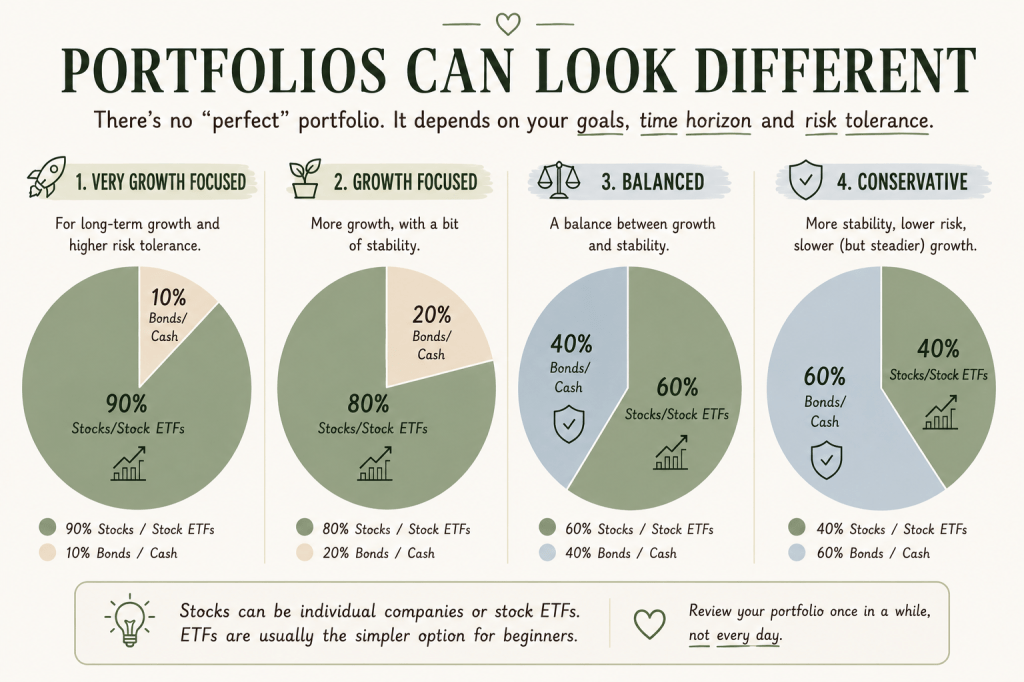
Someone investing for retirement in thirty years’ time has a very different time horizon from someone hoping to buy a house in five years. Likewise, someone who remains perfectly calm during market downturns may be comfortable with a different (higher risk) portfolio from someone who loses sleep every time they see a red number.
There’s no universally perfect allocation because there are no universally identical lives.
This is one of the reasons I try not to pay too much attention to other people’s portfolios. Social media has made investing feel strangely competitive, with creators sharing screenshots of impressive returns or announcing the latest fund they’ve just added to their portfolio. It’s entertaining, but it can also create the impression that successful investing requires constant action.
In reality, many of the most successful investors spend remarkably little time changing their portfolios.
Once they’ve built a strategy they believe in, their focus shifts towards continuing to invest consistently rather than endlessly searching for something better. I think that’s a much healthier approach.
It’s very easy to spend weeks comparing two ETFs with almost identical holdings, or reading dozens of opinions about whether one fund is marginally better than another. Meanwhile, the months pass, your cash remains uninvested and the decision becomes more intimidating with every article you read. Eventually, you have to accept that investing isn’t an exam where there’s only one correct answer.
There are many sensible portfolios. Some will perform slightly better than others over certain periods, but nobody knows in advance which those will be. That’s why I believe your first portfolio should aim to be sensible rather than perfect.
As your knowledge grows, it’s entirely possible that your portfolio will evolve as well. You might decide to add exposure to different regions, include another asset class or even allocate a small percentage to individual companies that genuinely interest you. That’s part of the learning process, and it doesn’t mean your original portfolio was wrong. It simply means you’ve continued learning.
I sometimes think beginners put far too much pressure on this first decision because it feels permanent. In reality, very little about investing is permanent. You can make additional investments, rebalance your portfolio, change your monthly contributions and refine your strategy as your life changes.
Your first portfolio isn’t your final portfolio. It’s your starting point.
That’s an important difference, because it removes the pressure to get everything exactly right from day one. You’re not making one decision that has to carry you through the next forty years. You’re taking the first step on a journey that will almost certainly evolve as you gain experience and confidence.
In the next chapter, we’ll look at the mistakes that cause many new investors to lose confidence, not because investing is especially difficult, but because our own psychology often convinces us to do exactly the wrong thing at exactly the wrong time.
12. The Biggest Mistakes New Investors Make (And How to Avoid Them)
By this point, you’ve probably noticed that investing itself isn’t actually the difficult part. Understanding ETFs, opening a brokerage account and building a simple portfolio are all surprisingly manageable once someone explains them properly. What tends to trip people up isn’t a lack of knowledge; it’s the decisions they make once real money is involved.
That might sound a little strange at first, but I think it’s one of the most fascinating things about investing. Two people can read exactly the same books, invest in exactly the same ETF and start with exactly the same amount of money, yet twenty years later they can end up with completely different results. The reason usually isn’t that one of them discovered a brilliant strategy that the other person missed. More often, it’s because one person stayed the course while the other constantly changed direction.
Looking back, I don’t think the biggest mistakes I almost made had anything to do with choosing the wrong ETF or opening the wrong brokerage account. Most of them happened long before that.
#1 Believing that you need to know absolutely everything before you’re allowed to start
I kept telling myself that I just needed to read one more article, compare one more fund or watch one more YouTube video before I felt confident enough to invest. At the time, that felt like the responsible thing to do. In reality, I was trying to eliminate uncertainty, and that’s simply not possible. There will always be another opinion, another strategy and another expert explaining why their approach is the best one. At some point you have to accept that learning and investing happen alongside each other, not one after the other.
#2 Assuming that a falling market automatically means you’ve made a bad decision
Imagine you’ve finally built up the confidence to invest for the first time. A week later you log into your account and your portfolio is worth 10% less than when you bought it. Even if you knew intellectually that markets fluctuate, it’s difficult not to wonder whether you’ve done something wrong. Your brain immediately starts looking for an explanation. Maybe you invested at the worst possible time. Maybe you should have waited. Maybe everyone else knew something that you didn’t.
The uncomfortable truth is that sometimes the market simply falls.
It doesn’t mean your strategy has failed, and it doesn’t mean you suddenly became a bad investor overnight. Market declines are a normal part of long-term investing, even though they rarely feel normal when you’re experiencing your first one. One of the biggest mindset shifts for me was realising that a lower portfolio value doesn’t automatically require a different plan. If my goals haven’t changed and I’m still investing for the long term, then a temporary decline is just that: temporary.
#3 Constantly checking your investments
When I first started, there was a strange temptation to open my investing app every day, even though I had absolutely no intention of selling anything. It became a habit more than anything else. If the market was up, I felt pleased. If it was down, I felt disappointed. Neither emotion was particularly useful because nothing about my long-term plan had actually changed between Monday and Tuesday. Constantly checking your investments creates far more stress than it creates value
Imagine planting an apple tree in your garden. You wouldn’t walk outside every evening hoping it had suddenly grown another twenty centimetres overnight. You’d water it, look after it and trust that growth takes time. Investing works in much the same way. Progress is happening whether you watch it every day or not.
#4 Comparing your financial succes to others on social media
Social media has introduced another challenge that didn’t exist to the same extent a generation ago. It’s almost impossible to scroll through your phone without someone talking about the latest stock that’s “guaranteed” to explode, the ETF everyone is suddenly buying or the investment they wish they’d made six months earlier. After a while, it starts to feel as though everyone else has discovered opportunities that you’ve somehow missed.
Most of the time, that’s an illusion.
People naturally share their successes far more often than their mistakes. You’ll see screenshots of portfolios after they’ve doubled in value, but you rarely see the investments that quietly lost money or the decisions people regret making. It’s very easy to compare your everyday investing journey with someone else’s highlight reel, and it’s almost never a fair comparison. And don’t get me started on all the rented Lamborghinis and fake success stories…
#5 Being a perfectionist
Perhaps the biggest lesson I’ve learned is that successful investors don’t usually win because they avoid every mistake. They win because they avoid the mistakes that matter. Buying one ETF instead of another with slightly lower fees probably won’t determine your financial future. Starting five years later because you were waiting to feel completely ready might.
The same is true of changing your investment strategy every few months. Markets change, headlines change and opinions certainly change, but constantly chasing whatever feels exciting at the time usually makes investing harder than it needs to be. A simple plan that you continue following for twenty years will almost always achieve more than a brilliant plan that you abandon after six months.
That’s why I think the real goal isn’t becoming the perfect investor. It’s becoming a consistent one.
You’ll make mistakes because everyone does. You’ll occasionally wish you’d invested earlier, bought a different ETF or ignored a particular headline. Those moments are part of the learning process, and they don’t define whether you’ll be successful over the next thirty years. What matters far more is whether you keep going.
In the next chapter we’ll talk about market crashes, because sooner or later every investor experiences one. The interesting question isn’t whether they’ll happen; we already know they will. The question is how you’ll react when they do.
13. What Happens When the Market Falls?
If there’s one thing almost every new investor worries about, it’s this.
“What happens if I invest my money… and then the market crashes?”
It’s a fair question, and if I’m honest, it’s the one I spent the most time thinking about before I made my first investment. It’s easy to feel excited about investing when every graph you’ve looked at seems to go up over the long term, but the moment you realise those graphs also include some very steep drops, your confidence starts to wobble a little. You begin wondering whether it might be better to wait until things feel a bit more certain before getting started.
The problem is that the market has never been particularly good at feeling certain.
There is almost always something happening somewhere in the world that makes people nervous. Sometimes it’s inflation, sometimes it’s a recession, an election, a war, rising interest rates or a global pandemic. If you read enough financial news, you’ll quickly come to the conclusion that there’s never a “good” time to invest because there always seems to be another reason to wait.
That was something I found surprisingly comforting once I realised it. I had assumed experienced investors were waiting patiently for the perfect moment to invest, but the more I learned, the more I realised that most long-term investors don’t spend their lives trying to predict the next six months. They accept that uncertainty is part of the process and build a strategy that doesn’t depend on getting the timing exactly right.
That doesn’t mean market crashes aren’t unpleasant.
Imagine you’ve been investing every month for a couple of years and one morning you log into your brokerage account to find that your portfolio is worth 20% less than it was a few weeks ago. Even if you know that markets fluctuate, it’s still an uncomfortable feeling. Seeing red numbers next to your investments isn’t enjoyable, and it’s perfectly natural to wonder whether you’ve made a mistake.
When I first started learning about investing, I assumed that a falling market meant something had gone fundamentally wrong. I imagined that if my portfolio dropped significantly, it must mean the companies I’d invested in were suddenly failing or that I’d chosen the wrong investment altogether. It took me a while to separate what was happening in the market from what was happening inside the businesses I owned.
Let’s go back to the example we’ve used a few times already.
Imagine you own part of a bakery that’s been doing well for years. People still queue outside every morning, the bread is still selling, the staff are still coming to work and the business is still making money. Then, for whatever reason, someone offers to buy your share for less than they would have paid last month.
Has the bakery changed?
Not necessarily.
The offer has changed.
That’s an important distinction because the stock market is essentially doing exactly that every single day. Investors are constantly deciding what they’re willing to pay for businesses, and those opinions change much more quickly than the businesses themselves. Sometimes prices become overly optimistic and rise very quickly. At other times, fear takes over and prices fall just as quickly. Neither situation automatically tells you what those businesses will be worth ten or twenty years from now.
This was probably the biggest mindset shift I had to make.
Instead of looking at my portfolio and asking, “How much money have I lost?”, I started asking myself a different question: “Has the reason I invested changed?” If I was still investing for the next twenty or thirty years, still believed that businesses would continue growing over time and still didn’t need that money any time soon, then my plan hadn’t really changed at all. The only thing that had changed was the price someone else was willing to pay for my investments today.
Of course, that’s much easier to understand when you’re reading about it than when you’re living through it. During every major market downturn, there will be headlines predicting more losses, people announcing that they’re selling everything and commentators explaining why this time is different. It’s incredibly difficult not to get caught up in that atmosphere, especially if it’s your first experience of a falling market.
History is full of moments when people genuinely believed the market would never recover. During each financial crisis, it felt as though the future had permanently changed. Yet when you zoom out and look at decades rather than months, you see something rather remarkable. Businesses adapt. New companies emerge. Old industries evolve. Economies recover. None of that happens overnight, and nobody can tell you exactly how long the recovery will take, but history has shown us time and time again that periods of uncertainty are part of investing, not evidence that investing has stopped working.
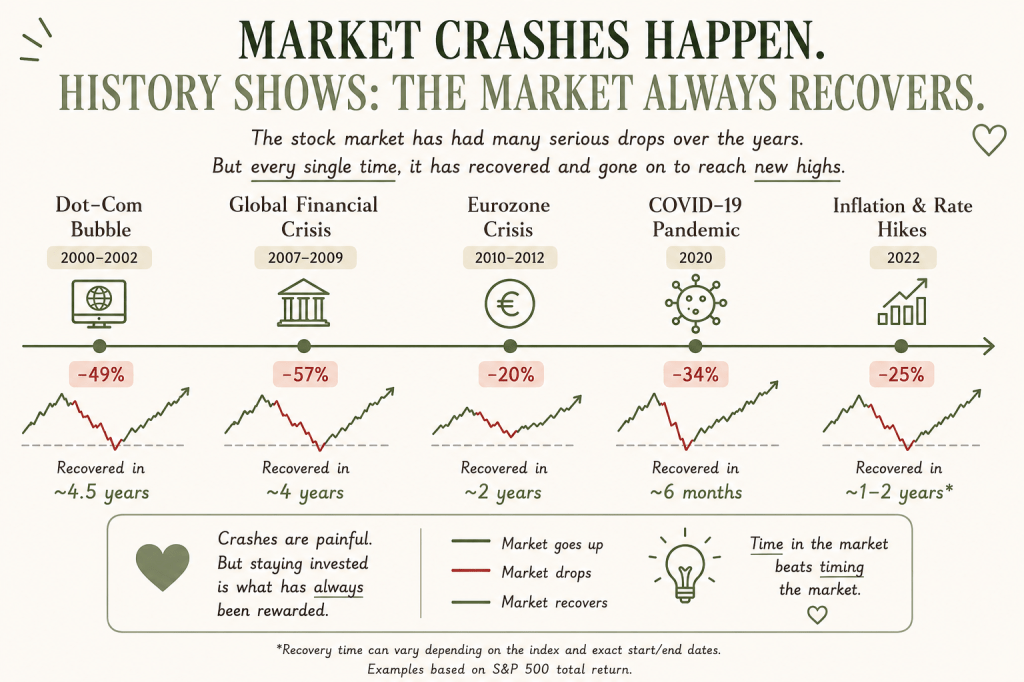
That’s also why I think it’s so important to invest money that you genuinely won’t need in the near future. If you’re relying on that money to buy a house next year or pay next month’s bills, a falling market becomes a real problem because you may be forced to sell at exactly the wrong moment. If, however, your investment horizon is measured in decades rather than months, you have something incredibly valuable on your side: time.
I’ve found that the less I pay attention to short-term market movements, the more enjoyable investing becomes. I still read financial news because I’m interested in it, but I no longer feel as though every headline requires me to make a decision. Most of the time, it doesn’t. My monthly investments continue whether the market is having a fantastic week or a terrible one, because my plan was never built around trying to guess what would happen next Tuesday.
I think that’s one of the biggest differences between investing and speculating. A speculator spends a lot of time trying to predict what the market will do next. A long-term investor spends far more time thinking about where the world is likely to be in ten, twenty or thirty years.
Those are two very different conversations.
The next chapter is all about building a habit that makes long-term investing even easier. Instead of wondering whether this month is the right time to invest, we’ll look at why so many investors prefer to remove that decision altogether and simply invest on a regular schedule.
14. How Often Should You Invest?
Once people decide they want to start investing, the next question usually isn’t what to invest in anymore.
It’s when.
Should you invest everything as soon as you have the money? Should you wait for the market to fall? Should you invest once a month, once every few months, or only when you think prices look attractive?
When I first started learning about investing, I assumed there had to be a clever answer to that question. Surely experienced investors had figured out some sort of pattern. Maybe they avoided investing when markets were at all-time highs, waited patiently for corrections and then bought at exactly the right moment.
It turns out that’s much easier to imagine than it is to do.
The challenge with trying to time the market is that you don’t just have to make one good decision; you have to make two. First you have to decide when to get your money into the market, and later you’ll need to decide when to take it out again. Both decisions have to be right, and both decisions have to happen consistently over many years.
That’s a remarkably difficult thing to do.
Even professional investors, armed with teams of analysts and access to more information than most of us could ever dream of, regularly get it wrong. Markets react to thousands of different factors, many of which nobody can predict with any real accuracy. Economic data changes, interest rates move, political events unfold unexpectedly and sometimes markets simply behave in ways that don’t seem particularly logical.
Once I accepted that, I stopped worrying about trying to find the perfect moment to invest.
Instead, I became much more interested in finding a strategy that I could follow without constantly second-guessing myself.
For me, that strategy was investing a fixed amount every month.
You may have heard this referred to as dollar-cost averaging, although the name changes depending on where you live. The principle, however, is always the same. Rather than trying to predict what the market is going to do next, you invest at regular intervals regardless of whether prices are high, low or somewhere in between.
At first, that almost felt too simple. Surely I should be paying more attention than that?
But the more I thought about it, the more sense it made. If markets happened to fall after I’d invested, my next monthly contribution would simply buy more units than it would have the month before. If markets continued rising, then at least part of my money had already been invested and was benefiting from that growth.
Either way, I didn’t have to make a decision every single month. That turned out to be one of the biggest advantages.
The less often I had to ask myself, “Is now a good time to invest?”, the less opportunity there was for fear, excitement or headlines to influence my behaviour. Investing gradually became something I did in much the same way as paying rent or transferring money into my savings account. It wasn’t an emotional decision anymore. It was simply part of my monthly routine.
There’s something surprisingly powerful about removing decisions that don’t need to exist.
Think about brushing your teeth.
You probably don’t wake up every morning and weigh up whether today feels like a good day to brush them. You’ve repeated the habit so many times that it barely requires any thought at all. Investing can become much the same. Once it’s built into your monthly routine, it stops feeling like a big financial decision and starts feeling like something you simply do for your future self.
Of course, life isn’t always predictable.
Some months you’ll be able to invest more than usual. Other months unexpected expenses will mean you contribute less, or perhaps not at all. That’s perfectly normal. I think people sometimes become so focused on following a plan perfectly that they forget real life rarely follows a perfect script.
Consistency doesn’t mean perfection. It simply means returning to the plan whenever you can.
I also think it’s worth remembering that investing isn’t a race. There isn’t a prize for making the most contributions in a single year, just as there isn’t a punishment for needing to pause while you deal with other financial priorities. Over the course of thirty years, one missed monthly investment is unlikely to determine your financial future. Giving up altogether because you feel you’ve fallen behind is a much bigger risk.
Looking back, I’m glad I stopped trying to outsmart the market before I’d even invested my first euro. I could easily have spent years waiting for the perfect opportunity while my money sat in a savings account earning very little. Instead, I chose a strategy that removed most of the guesswork and allowed me to focus on the one thing I could actually control: continuing to invest regularly.
That’s one of the recurring themes you’ll probably have noticed throughout this guide.
There are countless things we can’t control as investors. We can’t control interest rates, recessions, elections, company earnings or tomorrow’s headlines. We can, however, control how much we invest, how consistently we invest and whether we stick with our plan when the market inevitably becomes noisy.
Those are the decisions that tend to matter most over the long term.
The next chapter takes a brief look at taxes. I know that’s nobody’s favourite subject, but understanding a few basic principles now can save you a surprising amount of confusion later, and it’s much less intimidating than it first appears.
15. Understanding Taxes (Without Getting a Headache)
Taxes aren’t the most exciting part of investing. In fact, if you’re reading this guide because you’re finally feeling motivated to build your first portfolio, this is probably the chapter you’re most tempted to skip. I completely understand that. When I first started learning about investing, I wanted to know about ETFs, market crashes and compound interest. Tax rules felt like something I’d worry about years later.
The problem is that a little knowledge now can save you a lot of confusion later.
The good news is that you don’t need to become a tax expert before you start investing. In fact, I’d argue that’s another mistake people sometimes make. They convince themselves they need to understand every possible tax rule before they’re allowed to buy their first ETF, when in reality most beginners only need a basic understanding of how investing is taxed in the country where they live.
The first thing to know is that tax rules aren’t universal.
An investor living in Spain will be subject to different rules from someone living in the United Kingdom, Belgium or the United States. Some countries tax dividends differently, others have capital gains allowances, while some offer tax-efficient investment accounts that simply don’t exist elsewhere. That’s why I always recommend reading information that’s specific to your own country rather than assuming advice from someone on YouTube automatically applies to you.
It’s also worth remembering that tax rules change.
Governments regularly adjust allowances, rates and reporting requirements, which means an article written a few years ago may no longer be completely accurate. If you’re ever unsure, it’s always worth checking the latest guidance from your country’s tax authority or speaking to a qualified accountant if your situation becomes more complicated.
For most people starting out, however, investing is actually much simpler than they expect.
You’ll generally come across two terms quite quickly: dividends and capital gains.
Dividends are payments that some companies make to their shareholders, usually from a portion of their profits. If you own shares in a company (or an ETF that distributes dividends) you may receive those payments periodically throughout the year.
Capital gains are different. They refer to the increase in value of an investment between the time you buy it and the time you sell it. If you buy an investment for €1,000 and eventually sell it for €1,500, the €500 increase is your capital gain. Whether or not you pay tax on that gain depends entirely on the rules where you live.
One thing that confused me at the beginning was the difference between accumulating and distributing ETFs.
A distributing ETF pays dividends out to you as cash. An accumulating ETF automatically reinvests those dividends back into the fund instead. Neither option is inherently better than the other, but depending on where you live, they can have different tax implications as well as different practical advantages. It’s one of those small details that’s worth understanding before you invest, even though it doesn’t need to keep you awake at night.
I also think it’s important not to let tax considerations completely dictate your investment decisions.
Of course, nobody wants to pay more tax than necessary, and using legitimate tax-efficient accounts or allowances makes perfect sense where they’re available. At the same time, I’ve seen people spend weeks trying to save a relatively small amount of tax while delaying their investments altogether. That’s a trade-off that’s easy to overlook.
Paying a reasonable amount of tax because your investments have grown substantially is usually a much better outcome than paying no tax because you never invested in the first place.
That’s one of those ideas that sounds obvious once you say it out loud, but it’s surprisingly easy to forget when you disappear down internet rabbit holes comparing tax strategies.
My advice is to keep things simple. Learn the basic rules that apply in your country. Keep good records of your investments from the very beginning, even if your broker already provides statements, because being organised makes life much easier later. As your portfolio grows or your financial situation becomes more complicated, you can always learn more or ask a professional for advice.
You don’t have to know everything today. You just need to know enough to get started confidently and avoid the most common mistakes. That’s really been the theme running through this entire guide.
You don’t need to become an economist before buying your first ETF. You don’t need to predict the next market crash before investing your first euro. And you certainly don’t need to memorise your country’s tax legislation before opening a brokerage account.
Investing is a skill you build over time. The more experience you gain, the more these topics begin to feel familiar, but there’s no requirement to master them all on day one.
In the next chapter, we’ll answer some of the questions that almost every beginner asks at some point. They’re the sort of questions that don’t always fit neatly into a chapter of their own, but they’re well worth answering before you make your first investment.
16. Questions I Wish I’d Asked Sooner
By the time you’ve made it this far, you’ve probably realised that investing isn’t nearly as complicated as it first appears. Most of the mystery comes from unfamiliar terminology rather than the concepts themselves. Once someone explains what a stock, an ETF or an index fund actually is, you start wondering why nobody ever explained it that way before.
That doesn’t mean all your questions disappear.
In fact, I think learning about investing has a funny way of creating new questions just as quickly as it answers old ones. That’s completely normal. I certainly didn’t reach the end of my first investing book and suddenly feel like I knew everything. If anything, I became even more curious.
There are a handful of questions that seem to come up over and over again, so before we finish this guide, I’d like to answer a few of them.
“What if I invest and the market falls the next day?”
This is probably the most common fear people have before making their first investment, and hopefully by now you already know the answer.
Nothing has gone wrong.
It might feel as though you’ve picked the worst possible moment to start, but unless you needed that money next week, a short-term fall doesn’t automatically change your long-term plan. Every experienced investor has invested before a market downturn at some point. It’s impossible to avoid completely because nobody knows when those downturns will happen.
“Should I wait until I have more money?”
I used to think investing was something people started once they were already financially comfortable. Looking back, I’m glad I eventually realised I’d got that the wrong way round.
Waiting until you have more money isn’t necessarily a bad decision if you’re paying off high-interest debt or building an emergency fund. Waiting simply because you think your monthly contribution isn’t “big enough” is a different story.
Most people don’t begin their investing journey by putting thousands of euros into the market every month. They begin with whatever they can realistically afford.
Imagine investing just $50 a month into an S&P 500 index fund. Over 30 years, you would contribute a total of $18,000. Assuming an average annual return of 8%, your investment could grow to approximately $74,500. In other words, your money would have earned around $56,500 in returns, all thanks to the power of compound interest! Small, consistent investments really can add up over time.
“How often should I check my portfolio?”
Less often than you think.
When you’re new to investing, it’s incredibly tempting to check your account every day. I did exactly the same thing. It feels productive, almost as though keeping a close eye on your investments somehow makes you a better investor.
In reality, constantly watching short-term movements often creates more anxiety than insight. If your plan is to invest for the next twenty or thirty years, knowing what happened on a random Tuesday afternoon isn’t usually going to change anything.
These days, I still enjoy following financial news because I find it interesting, but I no longer feel the need to treat every market movement as something that requires my attention.
“Can I ever change my investment strategy?”
Absolutely!
One thing I hope this guide has made clear is that your first investment doesn’t have to be your last decision. You’ll learn more over time, your income will probably change, your financial goals may evolve and your portfolio can evolve alongside them.
There’s a big difference, though, between making thoughtful changes because your circumstances have changed and constantly changing direction because you’ve read another opinion online.
The first is part of learning.
The second usually creates unnecessary stress.
“Is it too late for me to start?”
I wish nobody ever had to ask this question, but it’s one I hear surprisingly often.
The honest answer is that earlier is better.
The equally honest answer is that earlier is no longer an option.
Whether you’re twenty-five, forty-five or sixty-five, the only decision you can make today is whether you want your future self to be glad you started NOW. Looking backwards doesn’t change your portfolio. Looking forwards still can.
“Will I ever feel like I know what I’m doing?”
Probably not in the way you imagine.
One of the biggest surprises for me was realising that experienced investors don’t know what the market will do next either. They don’t have a crystal ball, and they don’t suddenly reach a point where every financial decision feels obvious.
What changes is their relationship with uncertainty. They stop expecting to know exactly what’s coming and instead build a strategy that doesn’t depend on knowing. I think that’s a much healthier way to approach investing, and honestly, it’s one of the biggest lessons I’ve taken away from this entire journey.
You probably won’t become someone who can predict the market, but you will become someone who knows what they’re talking about.
When I first started learning about investing, I honestly felt like everyone was speaking a different language. P/E ratios, ETFs, dividends, market caps… it all sounded intimidating, and every financial news article seemed impossibly complicated and, if I’m being honest, pretty boring. I remember wondering how people could possibly enjoy reading about this stuff.
But something funny happens when you stick with it. Little by little, the jargon stops feeling like jargon. Headlines that once made no sense suddenly become interesting. You start connecting the dots, understanding why markets move, and having conversations that would have completely gone over your head a year ago.
I’ve also found many interesting podcasts that are honestly fun to listen to, and various books that feel like light, enjoyable reads. These days, I genuinely enjoy reading books about investing, listening to finance podcasts on long drives, and keeping up with what’s happening in the markets. It no longer feels like homework, it feels empowering. My hope is that Money Looks Good On You becomes part of that journey for you too. I want this blog to be the place that makes finance feel less intimidating, more relatable, and even fun!
We’ve covered a lot throughout this guide, from understanding what investing actually is to building your first portfolio and preparing yourself for the inevitable ups and downs that come with investing over the long term. There’s just one final thing I’d like to leave you with before you make your first investment, because I think it’s the most important lesson of all.
17. Your First 30 Days as an Investor
If you’ve made it this far, I have one favour to ask. Don’t let this become another guide you read, think “that was helpful,” and then never act on.
You don’t need another week of research.
You don’t need another comparison video.
You don’t need to wait until next month.
You just need to begin.
The good news? Your first month as an investor doesn’t have to be complicated. In fact, here’s exactly what I’d focus on.
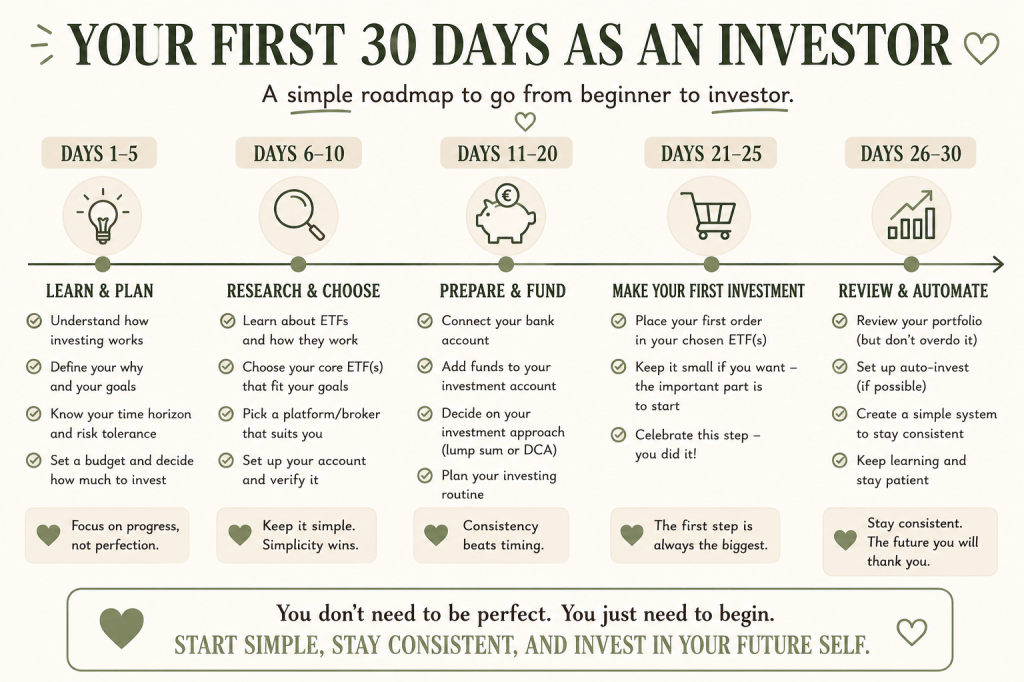
Days 1–5: Learn & Plan
You’ve already done most of the learning by reading this guide. Now it’s time to turn that knowledge into a simple plan.
By the end of these first few days, you should know:
- Why you’re investing in the first place.
- How much you can realistically invest each month.
- Your approximate investment time horizon.
- Whether you’re investing for retirement, financial freedom, a house, or simply growing your wealth.
Your goal isn’t to have the perfect strategy. It’s simply to have a strategy.
Days 6–10: Choose Your Investments
This is where people often get stuck. You’ll probably find yourself opening ten browser tabs comparing ETFs, reading Reddit threads, watching YouTube videos and wondering whether you’ve somehow missed “the best one.”
You probably haven’t!
- Choose a simple, diversified ETF that fits your goals.
- Choose a broker you feel comfortable using.
- Open your account.
- Stop researching.
Seriously.
You don’t need the perfect ETF. You need one you’re happy to keep investing in for years.
Days 11–20: Get Everything Ready
Now remove as much friction as possible.
- Connect your bank account.
- Deposit your first money.
- Decide whether you’ll invest monthly or whenever you have extra cash.
- If your broker allows automatic investing, this is the perfect time to set it up.
The easier you make investing today, the more likely you’ll still be doing it ten years from now.
Days 21–25: Make Your First Investment
This is the moment you’ve been building towards.
Click the button. Buy your first investment.
That’s it!
You might immediately open your portfolio five times to check whether it’s still there. You might worry you’ve clicked the wrong thing. You might panic because it’s gone down by €3.
Congratulations! You’ve officially become an investor!
Every single person has those thoughts in the beginning. Don’t confuse unfamiliar with wrong.
Days 26–30: Review & Automate
Now that you’ve started, your job changes completely. You’re no longer trying to become an investor. You are one. So instead of looking for things to improve every day, focus on building a system that lasts.
Ask yourself:
- Is my monthly investment amount realistic?
- Have I automated it if possible?
- Am I comfortable leaving this alone for years?
If the answer is yes, you’ve done exactly what you needed to do.
Your Only Goals for Month One
If you remember nothing else from this guide, remember these five things:
- Make your first investment.
- Invest consistently.
- Ignore the daily noise.
- Keep learning, but don’t keep changing.
- Let time do the heavy lifting.
That’s it. Not finding the perfect ETF. Not predicting the next market crash. Not beating everyone else. Just showing up, month after month.
Because investing isn’t won by the smartest people. It’s usually won by the people who stayed consistent long after everyone else got distracted.
Now close this guide.
Stop researching ETFs for the next six hours. You’ve learned enough to take the next step. Whether that’s investing your first €50, increasing your monthly contribution, or simply opening your brokerage account, just do the next thing.
You don’t need to know everything. You just need to get started.
Your future self will thank you!
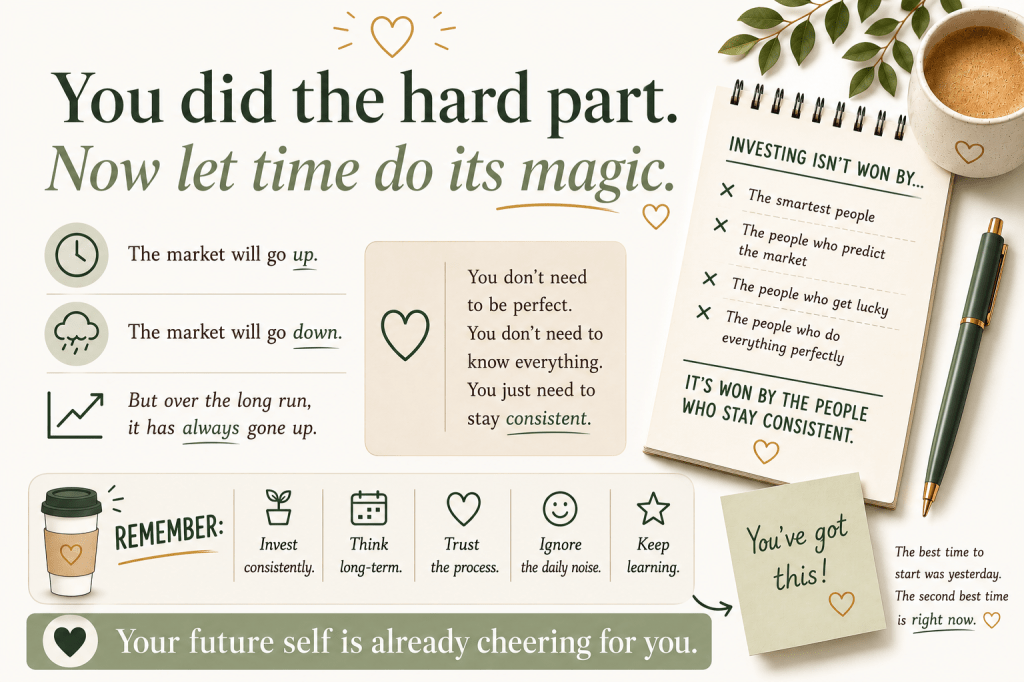
 Money looks good on you