
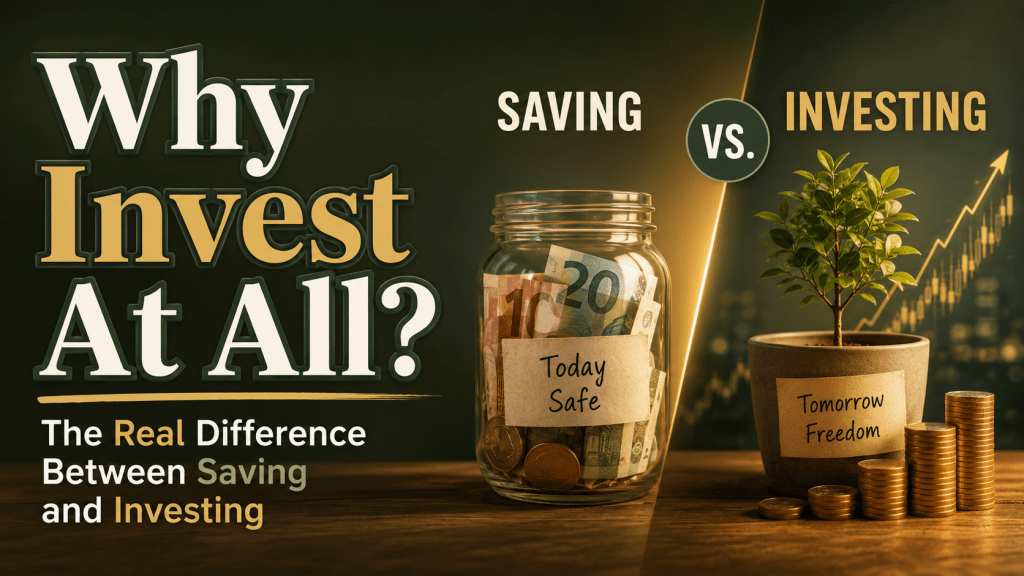
Why invest at all? The honest case for putting your money to work
Let’s start with an uncomfortable little truth: money sitting in a standard savings account is quietly losing value, even while the balance stays exactly the same.
That’s not a scare tactic. It’s just how inflation works. Prices tend to creep up every year, and if your savings aren’t growing at least as fast as prices are rising, your money buys a little less with each year that passes. You haven’t lost any pounds and pence, but you have lost purchasing power.
This is really the whole reason investing exists as a concept for ordinary people, not just for bankers in films. Investing is simply a way of trying to grow your money faster than inflation erodes it, over a long enough stretch of time that the ups and downs of the market smooth themselves out.
If you’ve ever wondered why so many finance writers (me included) go on about investing rather than just “saving harder,” this article is for you. I’ll walk through what actually separates saving from investing, why the difference matters more than most people realise, and how to think about it without needing a finance degree.
Saving and investing are not the same thing
It’s easy to lump these two together because they both involve putting money aside instead of spending it. But they behave very differently.
Saving typically means keeping your money somewhere safe and easily accessible, like a savings account. The value of your money doesn’t swing around. You know pretty much exactly what you’ll have tomorrow, next month, and next year (plus a small amount of interest, if you’re lucky).
Investing means putting your money into things that can grow in value over time, such as shares in companies, funds that hold a mix of investments, property, or bonds. The value can go up and down along the way, sometimes quite a lot, but historically, over long periods, investment markets have tended to grow faster than cash sitting in a savings account.
Here’s a simple way to picture it:
- Saving is like putting your money in a safe, snug little box. It stays the same shape, but so does the amount inside.
- Investing is like planting a seed. It needs patience, it might get battered by a storm along the way, but given enough time and the right conditions, it can grow into something much bigger than what you started with.
Neither approach is “wrong.” In fact, as we’ll get to, you generally need both.
Why cash savings alone often aren’t enough
Imagine you tuck £100 under your mattress (please don’t actually do this) and leave it there for ten years. When you pull it out, it’s still £100. But what could you buy with £100 ten years ago compared to today? Almost certainly more than you can buy now.
That’s inflation in action. It’s the reason a loaf of bread, a train ticket, or a night out cost less a decade ago than they do today.
Standard savings accounts do pay interest, which helps offset this. But historically, savings account interest rates have often struggled to keep pace with inflation, particularly during periods when prices are rising quickly. When that happens, your money is technically growing in number, but shrinking in what it can actually do for you.
This isn’t a reason to abandon saving altogether. Savings accounts are brilliant for one very important job: keeping your money safe and accessible when you need it soon. The problem only shows up when cash savings are used for goals that are many years away, where inflation has more time to nibble away at your buying power.
Why investing tends to work better over the long term
Investing gives your money a chance to grow through something wonderfully simple, and genuinely one of the most powerful ideas in personal finance: compound interest (sometimes called compound growth).
Compound interest is what happens when the returns your money earns start earning their own returns too. Rather than growth just sitting flat, it builds on itself, a bit like a snowball rolling downhill and picking up more snow as it goes.
Here’s a simplified example to show the idea (not a prediction of real returns, since markets don’t move in neat straight lines):
Say you invest £100 and it grows by 5% in year one. You’d have £105. In year two, that 5% growth applies to the new total of £105, not just your original £100, giving you £110.25. It looks small at first, but stretch that pattern out over 20 or 30 years and the snowball effect becomes genuinely dramatic.
This is why financial writers so often say time in the market beats timing the market. The longer your money is invested, the more time compounding has to work its quiet magic. It’s not about being clever or predicting the next big stock. It’s about starting, staying consistent, and letting time do the heavy lifting.
Of course, it’s only fair to be upfront about the flip side.
The risks: investing isn’t a guaranteed win
Investing comes with a trade-off, and it wouldn’t be honest to skip past it: the value of investments can go down as well as up, and you could get back less than you put in.
Unlike a savings account, where your balance doesn’t drop overnight, investments can lose value, sometimes sharply, particularly over shorter periods. Markets react to all sorts of things: economic news, company performance, world events, even general mood and confidence.
This is exactly why investing tends to suit money you won’t need for at least five years or more. That gives your investments room to recover from any dips along the way, rather than forcing you to sell at a bad moment because you suddenly need the cash.
A few honest ground rules worth keeping in mind:
- Nobody, however experienced, can reliably predict what markets will do in the short term.
- Diversifying (spreading your money across different investments rather than betting it all on one company or sector) can help manage risk, though it doesn’t eliminate it.
- Past growth doesn’t guarantee future growth. Just because something has performed well before doesn’t mean it will keep doing so.
If any of this sounds intimidating, that’s completely normal. Nearly everyone feels that way at the start. The goal isn’t to eliminate risk entirely, since that’s not really possible, but to understand it well enough that it doesn’t feel scary or mysterious.
So, should you save or invest?
Realistically, most people benefit from doing both, just for different jobs.
Good reasons to keep money in savings:
- An emergency fund, covering a few months of essential costs, so unexpected bills don’t derail you
- Money you’ll need within the next year or two, like a holiday, a house deposit you’re about to use, or a big purchase you’ve already planned
- Peace of mind. There’s real value in having accessible cash you’re not watching rise and fall
Good reasons to consider investing:
- Long-term goals, generally five years or more away, like retirement or building wealth over time
- Money you genuinely won’t need to touch in the short term
- Wanting your money to have a real chance of growing faster than inflation
Think of savings as your safety net and investing as your growth engine. They work best as a team, not as rivals.
A real-world example
Let’s make this a bit more concrete. Picture two friends, both starting with £1,000 they don’t need for at least ten years.
One keeps it entirely in a standard savings account. The other invests it in a diversified investment fund. Over that decade, the saver’s money grows slowly and steadily, protected from ups and downs, but likely struggling to outpace inflation. The investor’s money moves around more, some years up nicely, other years dipping, but historically, over a full decade, diversified investments have tended to grow more than cash savings, even accounting for the wobbles along the way.
Neither friend is being reckless or foolish. They’re simply using their money for different purposes, with different timeframes and different comfort levels around risk. That’s really what this comes down to: understanding your own goals and timeline, then choosing the tool that fits.
Key takeaways
- Savings accounts keep your money safe and accessible, but often struggle to outpace inflation over the long term
- Investing gives your money a chance to grow faster than inflation, thanks largely to the power of compound interest
- Investments can fall in value as well as rise, so investing suits money you won’t need for several years
- Most people benefit from a mix: savings for short-term needs and emergencies, investing for long-term goals
- Consistency and time matter more than trying to predict or time the market
A gentle nudge to get started
You don’t need to have it all figured out today. Understanding the difference between saving and investing is genuinely one of the biggest first steps toward feeling more in control of your money. From here, it’s simply a matter of building your knowledge piece by piece, at your own pace.
Ready to keep going? Next up in this series, we untangle the confusing jargon that puts so many people off investing before they’ve even started, so you can walk in feeling confident rather than out of your depth.
Frequently Asked Questions
Is investing only for people who are already wealthy? Not at all. Many investment platforms and funds let you start with very small, regular amounts. Investing is really about the habit and the time your money spends invested, not the size of the sum you begin with.
How much money do I need to start investing? There’s no fixed minimum that applies everywhere, and many platforms allow small regular contributions. We cover this in more detail in article three of this series.
Is investing basically the same as gambling? No. Gambling relies on chance with no underlying value, while investing means owning a stake in real companies, funds, or assets that can generate genuine long-term growth. That said, investing does carry real risk, and it’s sensible to treat it with respect rather than treating it as a sure thing.
What if the market crashes right after I invest? Market dips are a normal part of investing, and history shows that markets have generally recovered and grown over the long run, though this isn’t guaranteed for the future. This is why investing tends to suit money you can leave untouched for several years, giving it time to ride out any downturns.
Should I stop saving completely and just invest everything? No. It’s wise to keep an emergency fund and any money you’ll need in the short term in accessible savings. Investing works best for money you can comfortably leave alone for the longer term.
How do I know if I’m ready to start investing? A good general sign is having a small emergency fund in place, being free of high-interest debt, and having money you won’t need for at least five years. Everyone’s situation is different, so it’s worth reflecting on your own circumstances too.
Can I lose all my money by investing? It’s very unlikely with a diversified investment (one spread across many companies or assets) to lose everything, though values can still fall significantly, especially in the short term. Concentrating all your money in a single company or asset carries much higher risk.
 Money looks good on you